|
SuperTinyKernel™ RTOS 1.08.x
Lightweight, high-performance, deterministic, bare-metal C++ RTOS for resource-constrained embedded systems. MIT Open Source License.
|
|
SuperTinyKernel™ RTOS 1.08.x
Lightweight, high-performance, deterministic, bare-metal C++ RTOS for resource-constrained embedded systems. MIT Open Source License.
|
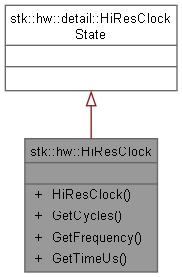
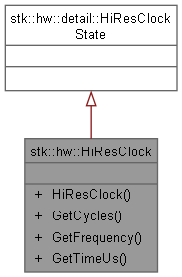
High-resolution clock for high-precision measurements. More...
#include <stk_arch.h>
Public Member Functions | |
| HiResClock () | |
| Construct a clock instance. | |
| Cycles | GetCycles () |
| Get number of clock cycles elapsed since the time origin (see the class description). | |
| uint32_t | GetFrequency () const |
| Get clock frequency. | |
| Ticks | GetTimeUs () |
| Get elapsed time in microseconds since the time origin (see the class description). | |
High-resolution clock for high-precision measurements.
mtime (reference clock) or, if STK_SUBMICORSECOND_PRECISION_TIMER is enabled, mcycle (CPU clock).Cycles value is the unit of the underlying counter: CPU cycles on ARM, CPU cycles or mtime reference ticks on RISC-V (see above), QueryPerformanceCounter ticks on x86-Win32. Always convert with GetFrequency() or use GetTimeUs(). DWT is not defined by the device header) the counter reads as 0. NSC_stk_hw_HiResClock_Init, NSC_stk_hw_HiResClock_GetFrequency, NSC_stk_hw_HiResClock_GetCycles) provided by the ARM Cortex-M back-end instead of calling this class directly. NSC_stk_hw_HiResClock_Init and NSC_stk_hw_HiResClock_GetCycles operate on an instance located in Non-Secure memory (the pointer is validated against the caller's access rights); NSC_stk_hw_HiResClock_GetFrequency takes no instance, the frequency does not depend on instance state. Definition at line 721 of file stk_arch.h.
|
explicit |
Construct a clock instance.
| Cycles stk::hw::HiResClock::GetCycles | ( | ) |
Get number of clock cycles elapsed since the time origin (see the class description).
Referenced by GetTimeUs(), and stk_hires_cycles().
| uint32_t stk::hw::HiResClock::GetFrequency | ( | ) | const |
Get clock frequency.
mtime reference clock or CPU clock on RISC-V; QueryPerformanceCounter frequency on x86-Win32). Referenced by GetTimeUs(), and stk_hires_frequency().
|
inline |
Get elapsed time in microseconds since the time origin (see the class description).
Definition at line 751 of file stk_arch.h.
References __stk_forceinline, GetCycles(), and GetFrequency().
Referenced by stk_hires_time_us().
 1.16.1